
Jiu Jitsu Tattoos: Japanese Tattoo Ideas, Culture & BJJ Inspiration
Walk into almost any Brazilian Jiu Jitsu academy and you will probably see plenty of tattoos. Look a little closer, and Japanese tattoos appear surprisingly often. Dragons, tigers, koi fish, snakes, octopuses, Oni, waves, and large Japanese sleeves all seem to fit naturally into BJJ culture.
The connection between Jiu Jitsu tattoos and Japanese tattooing goes beyond appearance. Brazilian Jiu Jitsu has historical roots in Japanese martial arts, while years of BJJ training tend to develop qualities such as discipline, patience, resilience, adaptability, and respect for technical mastery. Those ideas also translate naturally into the visual language of Japanese tattooing.
This is why a good BJJ tattoo does not necessarily need to show a belt, gi, or academy logo. A Japanese tattoo can express what Jiu Jitsu means to the person wearing it while still standing on its own as a strong piece of artwork.
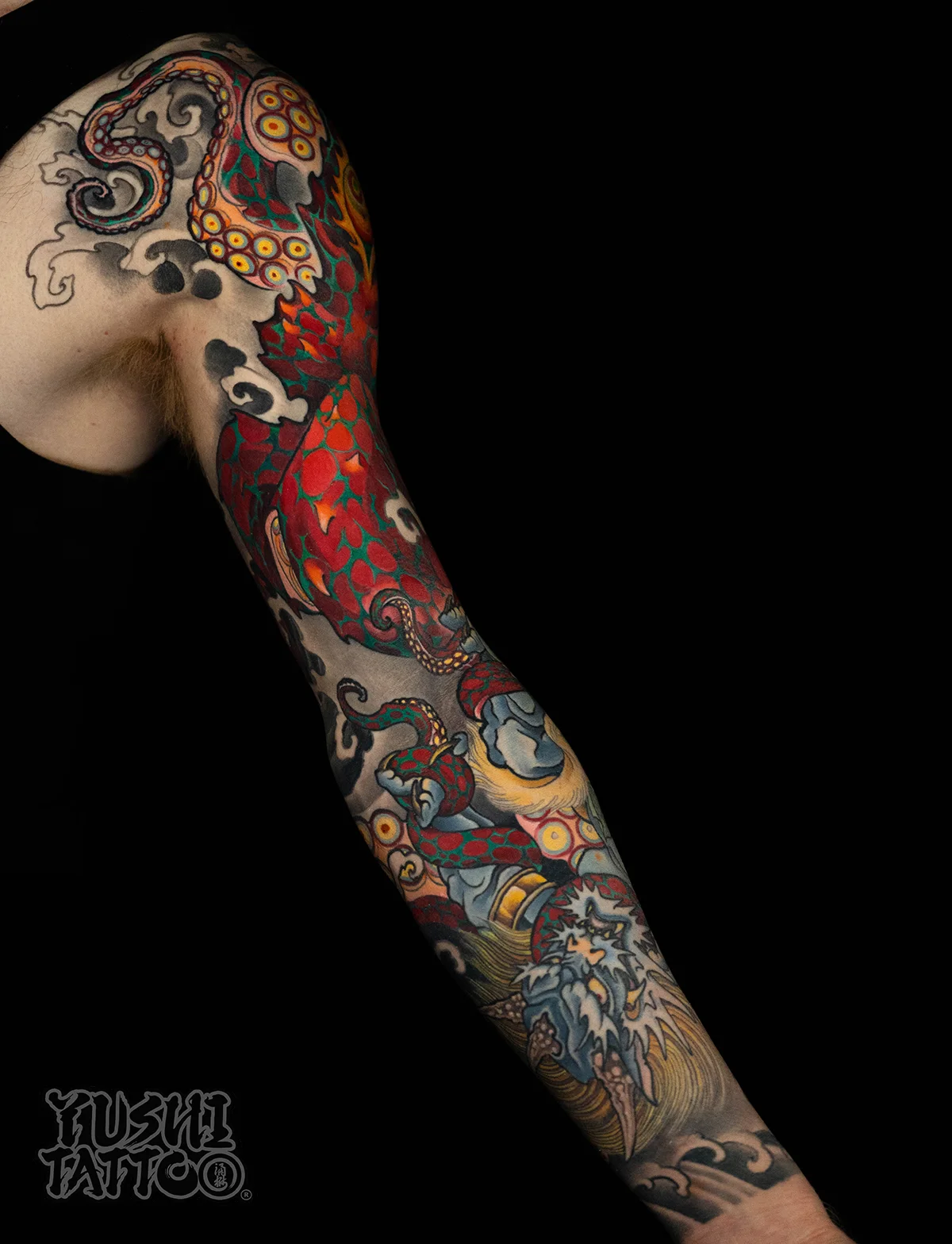
For Jiu Jitsu practitioners looking for something more personal, subjects such as an octopus using its tentacles like a grappler, frogs rolling with each other, or a human wrestling an Oni can create a connection between Japanese imagery and modern BJJ without becoming an obvious sports tattoo.
The Japanese Roots of Brazilian Jiu Jitsu
Modern Brazilian Jiu Jitsu developed in Brazil, but its history is closely connected to Japanese martial arts.
In the early 20th century, Japanese judoka Mitsuyo Maeda traveled internationally demonstrating and teaching his martial art. Maeda eventually arrived in Brazil, where he taught Carlos Gracie. The Gracie family and other practitioners continued developing these techniques over generations, eventually creating what we recognize today as Brazilian Jiu Jitsu.
BJJ developed its own techniques, competition system, and culture, but the Japanese influence remains visible. The gi, belt-ranking traditions, terminology, and many academy customs still reflect that history.
For someone interested in both Jiu Jitsu and Japanese culture, a Japanese Jiu Jitsu tattoo can therefore feel like a natural meeting point between the historical roots of the martial art and the personal experience of practicing it today.

Why Japanese Tattoos Fit Jiu Jitsu Culture
The connection between Japanese tattoos and Brazilian Jiu Jitsu is not only historical. The mentality required to stay with either one for years creates another interesting connection.
Anyone can take a few Jiu Jitsu classes, but becoming genuinely skilled requires years of repetition. You spend countless rounds dealing with uncomfortable positions, failed techniques, stronger opponents, injuries, and periods when your progress seems to stop completely.
Over time, that experience changes how many practitioners think about strength.
A beginner often tries to solve every problem by using more energy. An experienced grappler learns to conserve energy, recognize opportunities, remain calm under pressure, and apply technique at the right moment. Physical strength still matters, but it becomes much more useful when combined with patience and control.
Japanese tattoo imagery can express similar ideas without turning them into slogans. A tiger can communicate controlled physical power, a koi can represent persistence through resistance, and a dragon can combine strength with intelligence. An octopus can represent adaptability and problem-solving, while a snake can visually suggest control, movement, and changing direction.
This gives Jiu Jitsu practitioners a large vocabulary of imagery for creating a tattoo that represents their experience on the mat.
Jiu Jitsu, Resilience, and Learning How to Lose
One of the most valuable parts of Jiu Jitsu is also one of the least glamorous: you lose constantly.
You can get swept by someone smaller than you, submitted by someone less athletic, or completely controlled by someone with more experience. A technique that worked perfectly last week may suddenly fail against a better opponent.
Even after years of training, there will always be someone capable of making you feel like a beginner again.
That experience tends to change your relationship with failure. Losing becomes part of learning rather than the end of the process, and this is one reason themes of resilience and persistence resonate strongly with many people looking for Jiu Jitsu tattoo ideas.
A BJJ tattoo does not need to announce that the wearer is a fighter. It can simply represent the ability to remain calm, adapt to a bad position, learn from it, and return to training.
Japanese Tattoos and the Long Process of Mastery
There is another similarity between BJJ and large-scale Japanese tattooing: neither rewards impatience.
Reaching an advanced level in Jiu Jitsu can take many years of consistent training. Progress is often difficult to see from one week to the next, but the accumulated effect becomes obvious over time.
A Japanese sleeve, back piece, or bodysuit develops in a similar way. Large projects require planning, repeated tattoo sessions, healing, and returning to continue the work. Depending on the size and complexity, the final tattoo may develop over months or even years.
People who have spent years training Jiu Jitsu often understand this process instinctively. They are already familiar with committing to something that cannot be completed immediately and appreciating gradual progress.
Japanese Jiu Jitsu Tattoo Ideas
There is no requirement that a Jiu Jitsu tattoo literally depict Jiu Jitsu. In many cases, the more interesting approach is to take traditional or Japanese-inspired imagery and reinterpret it through the experience of grappling.
Some designs can be serious and symbolic, while others can be playful. What matters is creating a tattoo that works visually first and allows the Jiu Jitsu connection to exist naturally within the artwork.
Octopus Jiu Jitsu Tattoos
An octopus tattoo may be one of the easiest Japanese-inspired subjects to connect visually with grappling.
An octopus controls its surroundings using eight flexible arms. It can grab, pull, wrap, change direction, manipulate objects, and adapt quickly to its environment. Anyone familiar with grappling can immediately see why the animal has such an interesting visual relationship with Jiu Jitsu.
The tentacles can be composed to resemble hooks, grips, frames, entanglements, and control positions without literally illustrating a specific BJJ technique.
An octopus is also an excellent subject for a large tattoo because its tentacles can follow the anatomy of the body. They can wrap around an arm or leg, move across the torso, or connect different sections of a Japanese sleeve.
This does not mean the octopus is historically a symbol of Brazilian Jiu Jitsu. The connection is a modern interpretation, but that freedom is exactly what can make an octopus Jiu Jitsu tattoo more personal and original.

Frog Jiu Jitsu Tattoos
Not every BJJ tattoo needs to look serious or intimidating.
Japanese art has a long history of anthropomorphic animals, making frogs doing Jiu Jitsu a particularly fun tattoo concept. Two Japanese-style frogs can be shown grappling, wrestling, attempting submissions, or simply rolling together.
One frog might be working from guard while another tries to pass. A frog could be caught in an armbar or fighting for a back escape. They could wear gis and belts if the BJJ reference needs to be obvious, or the martial arts details could remain subtle.
A frog Jiu Jitsu tattoo combines humor with Japanese-inspired imagery and reflects an important part of BJJ culture that serious martial arts imagery sometimes misses. People spend years trying to submit their training partners, then shake hands and start another round.
For someone who wants an unusual BJJ tattoo idea, grappling frogs can be much more personal than simply tattooing a belt or the words Brazilian Jiu Jitsu.
Oni Wrestling and Jiu Jitsu Tattoos
An Oni wrestling tattoo offers a completely different direction.
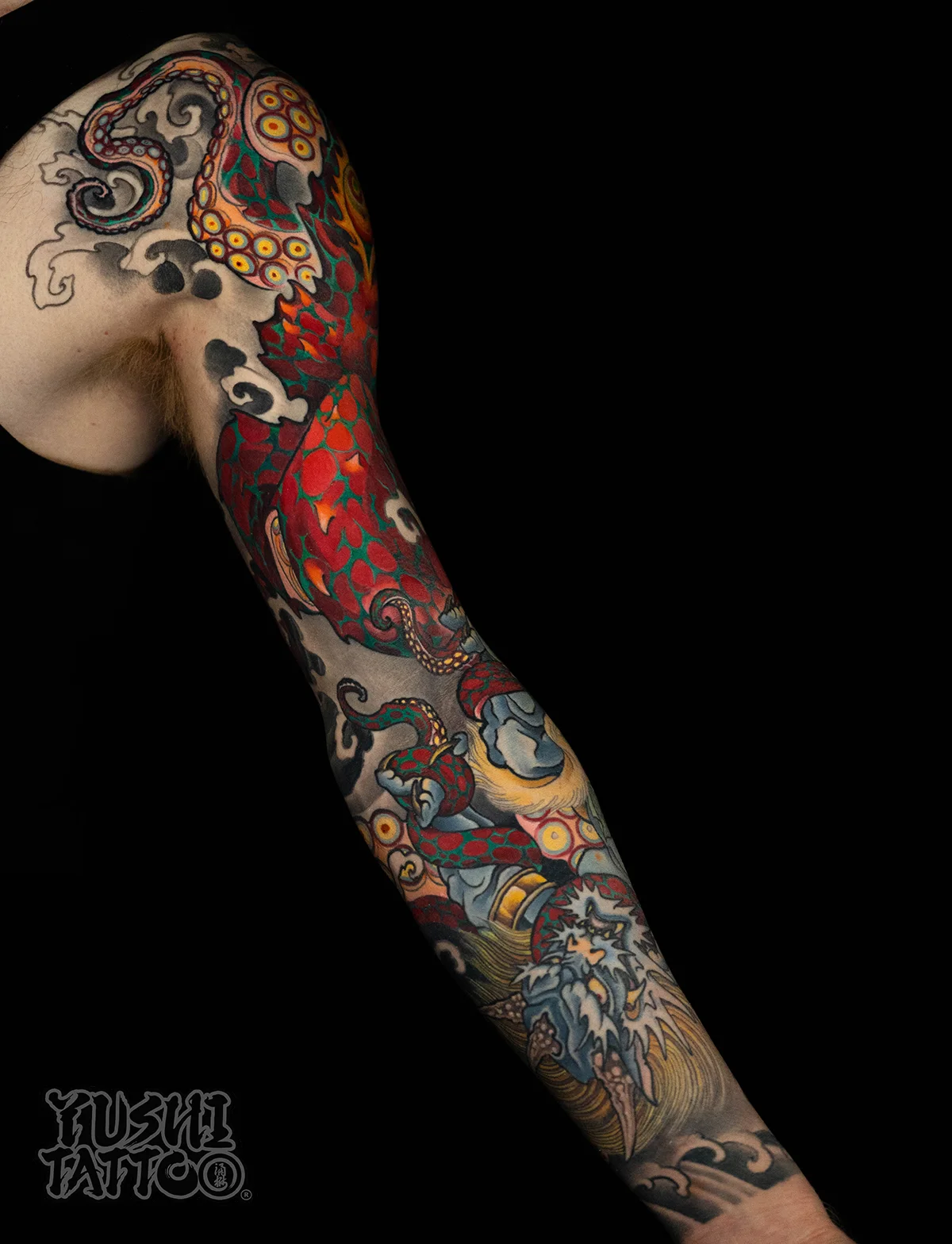
Oni are supernatural beings from Japanese folklore commonly portrayed as large, physically imposing figures with horns, fierce expressions, and tremendous strength. Rather than using an Oni only as a portrait, the tattoo can turn it into an entire grappling scene.
A human could be wrestling an Oni, or two Oni could be grappling with each other. The composition could incorporate a takedown, clinch, throw, guard position, or submission while maintaining the movement and visual character of Japanese tattooing.
A person grappling with an enormous Oni also creates an interesting metaphor for Jiu Jitsu. Anyone who trains eventually knows what it feels like to deal with someone who is much larger, stronger, or more experienced.
This concept works particularly well for larger tattoos because an Oni Jiu Jitsu tattoo can become a complete narrative scene. Wind, rocks, clouds, waves, and other Japanese background elements can transform the encounter into a full sleeve, leg sleeve, chest panel, or back piece.
The Oni is not a traditional symbol of Brazilian Jiu Jitsu, and it should not be presented as one. Instead, it provides a distinctly Japanese character that can be creatively reinterpreted through wrestling and grappling.
Japanese Tiger Tattoos for Jiu Jitsu
A Japanese tiger tattoo is a natural choice for someone attracted to the physical side of martial arts.
Tigers communicate strength immediately, but they do not have to represent aggression. Depending on the expression, posture, and composition, a Japanese tiger can feel calm and confident or explosive and powerful.
For a Jiu Jitsu practitioner, the tiger can represent becoming comfortable with pressure and learning how to control physical strength rather than simply using more of it.
Japanese Dragon Tattoos for Jiu Jitsu
A Japanese dragon tattoo works particularly well for martial artists because the dragon can combine physical power with intelligence and control.
The long body of a Japanese dragon also makes it ideal for sleeves, back pieces, and large compositions. Like a snake or octopus, the dragon can travel naturally around the anatomy rather than being placed on the body as an isolated image.
For practitioners who see Brazilian Jiu Jitsu as both a physical and intellectual discipline, a Japanese dragon provides plenty of room for personal interpretation.
Japanese Snake Tattoos for Grapplers
Snakes also have an obvious visual relationship with grappling. They coil, change direction, control space, and move using their entire bodies.
A Japanese snake tattoo works especially well on an arm or leg because the artist can use the snake’s body to follow the natural anatomy. For a grappler, that movement can suggest control, transitions, pressure, and attacking from unexpected directions.
As with the octopus, the connection does not need to be historically traditional. It can simply reflect what the image means to the person wearing it.
Why Japanese Tattoos Look So Good on Grapplers
There is also a practical design reason Japanese tattoos work particularly well on people who practice Jiu Jitsu.
Traditional Japanese tattoo compositions are designed around human anatomy. A sleeve wraps around the shoulder and arm, while a back piece uses the entire shape of the torso. Waves, wind, rocks, clouds, and flowers connect the major subjects so that the tattoo functions as one composition rather than a collection of separate images.
That becomes particularly noticeable when someone is grappling.
An octopus tentacle changes shape as the forearm rotates. A snake follows the movement of the leg. A dragon stretches across the back as the shoulders move. A large Japanese sleeve can look completely different depending on the position of the arm.
For someone whose sport involves constant movement, rotation, pressure, and physical contact, this relationship between tattoo composition and anatomy makes Japanese tattooing particularly interesting.
A BJJ Tattoo Doesn’t Need to Look Like a BJJ Tattoo
Some of the best Jiu Jitsu tattoo ideas may not be immediately recognizable as martial arts tattoos.
There is nothing wrong with tattooing a black belt, academy logo, or BJJ lettering, but someone looking for a larger artistic piece has many more possibilities.
An octopus can reflect adaptability learned through grappling. A koi can represent years of continuing despite slow progress. A tiger can represent confidence under pressure. An Oni wrestling scene can turn the struggle against a stronger opponent into a dramatic Japanese composition, while two frogs rolling can represent the friendships and humor that develop after years of training.
The tattoo can be deeply connected to Jiu Jitsu without needing to explain that connection to everyone who sees it.
Jiu Jitsu Tattoos in San Diego
The connection between Jiu Jitsu and Japanese tattooing is especially relevant in San Diego.
San Diego has a large and active Brazilian Jiu Jitsu community, with academies, competitors, instructors, and practitioners throughout the county. Because of that culture, we regularly work with clients who train BJJ and understand exactly what they are looking for when they want their tattoo to reflect their life on the mat.
At Oyabun Tattoo in San Diego, Japanese tattooing is one of our primary specialties, and Jiu Jitsu practitioners are a familiar part of our clientele. That experience is particularly useful when someone wants a tattoo influenced by BJJ without simply putting a martial arts logo on their body.
We can approach the idea from both sides: the visual structure of Japanese tattooing and the movements, humor, struggles, and culture familiar to people who actually train.
That might mean designing an octopus whose tentacles create the feeling of grappling, two Japanese frogs wrestling in a recognizable position, an Oni involved in a dramatic grappling scene, or a more traditional tiger, dragon, koi, or snake whose meaning connects personally with years of training.
For clients searching for a Jiu Jitsu tattoo artist in San Diego, BJJ tattoo in San Diego, or Japanese tattoo artist in San Diego, the goal should still be the same: create a strong Japanese tattoo first and allow the connection to Jiu Jitsu to become part of the story rather than forcing martial arts symbols into the design.